An AI coding agent writes a change in four minutes. The change then waits forty minutes for CI, a day for a free slot on staging, two days for a review, and until Thursday for the release.
That picture opens the manifesto of The Software Factory, a new community guide to building with AI coding agents. Its conclusion sets up everything else on the site: the agent was never the slow part. The line around it was built for people who type, and it still runs at their speed.
The guide is free and written in the open. It was started by Ofir Makmal, the founder of Marshal, as a community project. The code is under MIT, the words are under CC BY 4.0, and every page is a file in a public repository, so a pull request is the way to disagree with it.
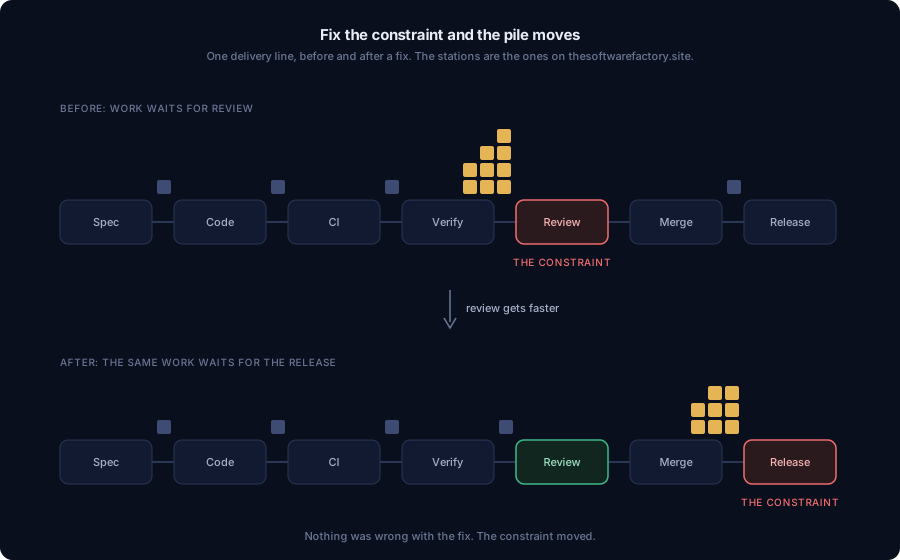
You tune a factory. You do not install one.
The guide defines a software factory as a software delivery line in which AI coding agents do most of the building, testing and shipping, and people decide what gets built and handle the exceptions. It is the line your team already has, from spec to release. In the guide's words, it is not a product, and nobody can sell you one.
That includes us. The manifesto ends with a list of things it refuses, and two of them are aimed squarely at companies like ours: "Any single product sold as a software factory" and "A vendor's answer to a process question. That includes the people who started this site." Marshal is a tool. A tool is one part of a line, and it earns its place when it relieves the constraint you actually have.
The argument for tuning is short. Speed up the developers and code review backs up. Fix review and QA drowns. Help QA and CI falls over. Fix CI and you run out of well-defined work to build. Every fix is real, and every fix moves the problem one station down the line.
Lights Out: watch the pile move
Reading that argument is one thing. Lights Out lets you feel it. It is a free simulator of a software delivery line with AI coding agents, and it puts you in charge of a ten-engineer team.
The floor has a machine for each station, and tasks arrive as boxes. Your job is to find the machine with a full meter and a growing pile in front of it. That is the constraint. Each station has a column of optimizations you can install, and ten days later the shift log tells you whether shipped tasks per day moved.
Then the pile drains, another one starts somewhere else, and you go back to step one.
Two details make the lesson stick:
- Early spend. The simulator adds up the price of every capacity optimization you install at a station that is not the constraint at that moment. You may need it later, but today it buys nothing. The lower that number is at the end, the better your grade.
- The lamps. Each person on the floor is a human gate. Automate the gate and they go home. You win when all five lamps are out.
You can also play it on your own line. "Diagnose my factory" takes rough numbers for your team, such as engineers, pull requests merged per week, CI run time, the wait for a first review, shared test environments and production deploys per week. The simulator then starts from your line, names your constraint today and suggests the first three moves.
The page is honest about its limits: "This is a model: wrong in the details, useful for the shape."
What else is in the guide
- The manifesto. Seven beliefs about shipping software with agents, and the list of refusals quoted above.
- The Playbook. Ten plays. Each one opens with a scene you will recognise and closes with a move for Monday. Give every agent its own environment. Agents prove their own work. Guardrails before autonomy.
- The journey. Six stages, from code written by hand to lights out, with the constraint that tends to show up first at each one.
- Stories. The first is an account of one R&D organisation that sped up its developers and then met six constraints in a row: developers, code review, quality, QA, DevOps, and then product.
Where Marshal fits, and where it does not
The manifesto says the constraint travels: from machines, to people, to the organisation. First it is laptops and CI minutes. Then it is one person's attention. Then it is trust, in the form of a security lead who will not allow autonomy or a team that will not merge what it has not read.
Marshal works on one stretch of that road. On the journey map, stage 1 is agents on laptops, where every action waits for an approval. The constraint there is approvals and laptop capacity, and the guide lists a sandbox, auto-approve and an agent dev platform as what usually relieves it. The play that goes with it is "Guardrails before autonomy": the person who says no is doing their job, so give them a reason to say yes. We have written about that trade-off before, in Ban It or Let It Run and in who approves when nobody is watching.
If your pile is in front of CI, or in front of the people who decide what to build, Marshal is not your next move, and the guide will tell you so. That is the point of it.
So start with the simulator. Play Lights Out until the next pile stops surprising you, then enter your own numbers.
If the constraint on your line turns out to be approvals, laptop capacity or trust in agent autonomy, that is the part Marshal handles: AI coding agents in isolated pods inside your own VPC, with credential isolation, audited egress and live tool policies. Book a demo →